Pictures of Heckel Discus Fish

Pictures of Heckel Discus Fish
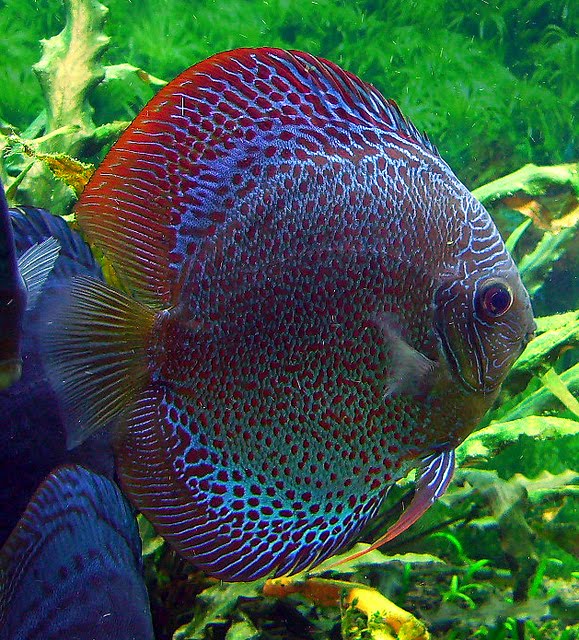
These following Tropical Fish Pictures are collection of Heckel Discus photos (Symphysodon discus 1840 ) taken by Scott Hanko at New York Aquarium. The base color of these fish is light brown to brown. Across the whole length of the body, 15 to 19 light blue horizontal and irregular striations. These striations start on the head and the cheeks and runs across the body up to the base of the caudal fin.

The Heckel discus is distinguished by the fifth prominent vertical bar (see pictures below). The eyes are gold to red. The ventral fins are red orange and they have a blue longitudinal band. These tropical discus fish come from Rio Negro (Brasil).

The Blue Face Heckel ( BFH) have the characteristics that the regular Heckel except that thy have the head in solid blue color. Some specimens have this solid condition through front half of the body. These discus fish species also come from Rio Unini and Rio Jaua (Brasil).

The Heckel Cross is a mix between a Heckel and a Blue, mainly from the Rio Madeira system. These fish have different characteristics, some best photos of discus show that this fish look like a standard blue with almost no striations in the body but with the fifth Heckel bar, other look like a Royal Blue Diamond Discus Fish with the fifth bar also.

Discus (Symphysodon spp.) like on tropical discus fish pictures below are a genus of three species of cichlid freshwater fishes native to the Amazon River basin. Discus are popular as aquarium fish and their aquaculture in several countries in Asia is a major industry. It's one of the best freshwater fish for aquarium.

Pictures of Heckel Discus FishDiscus fish belong to the genus Symphysodon, which currently includes three species: The common discus (Symphysodon aequifasciatus), the Heckel discus (Symphysodon discus), and a new species which has been named Symphysodon tarzoo. However, a further investigation published in August 2007 suggested that the genus held the three species: S. aequifasciatus (the green discus), S. haraldi (the blue/brown/common discus) and S. discus (the Heckel discus). Both studies suggest three species; the only disagreement is in the scientific names for each.

Like cichlids from the genus Pterophyllum, all Symphysodon species have a laterally compressed body shape. In contrast to Pterophyllum, however, extended finnage is absent giving Symphysodon a more rounded shape. It is this body shape from which their common name, "discus", is derived. The sides of the fish are frequently patterned in shades of green, red, brown, and blue. The height and length of the grown fish are both about 20–25 cm (8–10 in).

Another characteristic of Symphysodon species is their care for the larvae. As for most cichlids, brood care is highly developed with both the parents caring for the young. Additionally, adult discus fish produce a secretion through their skin, which the larvae live off during their first few days. This behaviour has also been observed for Uaru species. However when bred in captivity the larvae will tend to live off their parents secretion for up to 2 weeks.

Find more pictures of discus fish from people who breeding discus fish and hobbyists here on Tropical Fish Pictures. All fish photos have been divided by category to make finding of this best freshwater fish for aquarium images easier.
Read more

Easy Steps in Saving Money When Breeding Discus Fish

Tips for Breeding Discus Fish
It would be quick to fully grasp why so various freshwater aquarium fish enthusiasts loves the discus fish. It is highly attractive and most definitely one of the most breathtaking creatures that one can maintain and bred in an aquarium. Some would disagree saying that there are others even more stunning but that is just a matter of opinion, an opinion that millions of aquarium owners have created by owning Discus fish today.

This mesmerizing fish though comes with a hefty cost tag. Some sellers have been discovered to be selling their fish in the northern region of 250 dollars. That is quite stiff indeed, especially if you want to have a lot more than one fish, and if you're going to breed them, then a pair would definitely be required. But, if you want to have an aquarium full of discus fish and want to save revenue in doing so, then you would just have to breed them yourself.

Breeding Discus fish is not as difficult as you may well think it's not as hassle-free either. There certainly will be some costs, but if you do it ideal, you will be saving revenue in the lengthy run.In starting out, you have two solutions.

First selection - Initial is the specific choice, which is extra highly-priced although. All you have to do is go to a pet shop and obtain a breeding pair. This can set you back about 300 dollars. But you can be positive that one is a male and 1 is a female.

Second alternative - If you want to save some capital, but you cannot seriously be certain tht they would breed, is to obtain baby discus fish, about six to eight of them. You can just hope that at least one or two of them are male or female. Commonly though, there would be 1 of the opposite sex, so you would just have to wait until they grow up.

Breeding Discus Fish PicturesWhen they reach adulthood, you will soon observe that if there is indeed a pair, both of them will soon claim a space in the tank, and begin protecting it. This pair will then be your breeding pair. Have a breeding tank ready as soon as you discover them. A breeding tank should be separate from the most important tank so as to defend the spawn, at the least your breeding tank will need to be 20 gallons.

When you have lastly established your fish breeding tank, transfer some of the water from your original tank, this will stop your fish from experiencing tension in getting exposed to a new tank. Don't put any gravel or sand inside your tank, this will make it less difficult for you to clean your tank from leftover food. Just spot inside a vertical surface where your discus fish can spawn. You can use an upside down pot created from ceramic or live aquarium plants.

IT is imperative that you check on the water from time to time for rise in the water temperature and ammonia level. Everyday cleaning is also a should.If you want to save capital breeding discus fish, then avoid them from dying, a clean water will enhance your probabilities of breeding them from your initial investment.
Read more

Snakeskin Discus Fish

Snakeskin Discus Fish

Discus hobbyists have exciting new discus fish strain to satisfy their desire for new color forms. The careful blending of two colors has resulted in the creation of multi colored solid discus fish eg. Blue Diamond Discus and also resulted beautiful new spotted discus strains eg. Snakeskin, Turquoise and Red Spot green. With many names based on colored varieties resulting from controlled breeding, Symphysodon aequifasciatus is referred to as the Snakeskin Discus Fish.

The Snakeskin Discus has a mottled blue appearance against a red background. The overall coloration of Discus will vary depending on mood and overall health of the fish. The Discus has surpassed the Angelfish as the most popular freshwater aquarium fish. Depending on sub-species, the natural range of the Discus extends from the Amazon fish market to the Rio Negro Regions of South America.

The Snakeskin Discus requires an advanced level of care due to its feeding habits and water filtration requirements. The Snakeskin Discus included in peacefull fish category, it means the Snakeskin Discus fish do not pose a real threat toward other fishes, and are very passive and sometimes reclusive in nature.

Discus fish are becoming slightly territorial when breeding, it is best to breed an established pair, or maintain a group of young Discus and allow them to pair themselves. Warm, soft, slightly acidic water is required for spawning. The pair will clean a flat surface (usually a broad leaf or the side of the aquarium) prior to spawning. The parents must not be removed from the fry - the fry feed on their parents mucus.


Mostly carnivorous including Symphysodon aequifasciata or "Snakeskin Discus" prefer freeze-dried bloodworm and tubifex, pellet food designed for Discus, high-quality flake food, and meaty frozen foods. Find more stock photos of discus fish from breeders and hobbyists here on Tropical Fish Pictures. All photos of this "best freshwater fish for aquarium" have been divided by category to make finding of images easier.
Read more

Blue Diamond Discus Fish


The high quality of Blue Diamond Discus which been selectively bred have an excellent glowing blue pigmentation. It can be differentiating attribute may be the smaller white-colored white markings about it can be physique. Even though the overall coloration of Discus will vary according to feeling and also all-around health in the sea food.


The blue discus fish needs a professional a higher level care due to its eating behavior as well as h2o filter needs. Territorial in the course of spawning, this normally restful seafood is probably the education and learning class, creating new well-defined atomic family members.

Turning into a bit territorial any time propagation, it’s always best to reproduce an existing pair, as well as preserve several younger blue Diamond Discus and permit these to match by themselves. Warm, soft, slightly acid normal water is needed for breeding. You and your couple can clean up a flat surface area (usually a broad leaf or perhaps the facet of the aquarium tank) prior to creating. The parents must not be stripped away from the fry; the fry go after their own parent's mucous.

Mostly Discus fish types was predatory but the Blue Diamond Discus prefer freeze-dried bloodworm and also tubifex, pellet foods made for Discus, high-quality flake food, and meaty frozen foods obtained from Tropical Fish Suppliers.
Read more

Discus Fish - The King of Aquarium

Discus Fish Pictures- The King of Aquarium

Discus fish is also known as the king of aquarium and its quite popular among freshwater ornamental fish hobbiests. Many hobbiests are looking for this best freshwater fish for aquarium, therefore contributes to the price of Discus fish that expensive in the ornamental fish market, specially for the famous discus species. As a large number of people become a discus fish fans so its make the fish contests are often held and attended by many participants.

Discus Fish Pictures- The King of Aquarium

There are four species of nature discus, ie heckle discus, brown discus, green discus, and blue discus. As well as betta fish, the creativity of hobbies and also discus breeders in the cultivation is the discus fish secret how it spawned many new varieties of hybrid results premises color and complexion better than the original. In fact, you could say almost every year will come new types of discus fish with attractive colors and designs. Some of them can be found here including other Tropical Fish Pictures.

Discus Fish Pictures- The King of Aquarium
The quality standards of discus fish are determined from the physical as smooth, no defects, with scales intact, flat rounded shape to the side and slightly thicker, as well as an expanded tail fin perfect and no buds. Mostly, discus fish with the wide mouth and bright color, preferably like and it has a higher sale value too.
Read more