Easy Steps in Saving Money When Breeding Discus Fish

Tips for Breeding Discus Fish
It would be quick to fully grasp why so various freshwater aquarium fish enthusiasts loves the discus fish. It is highly attractive and most definitely one of the most breathtaking creatures that one can maintain and bred in an aquarium. Some would disagree saying that there are others even more stunning but that is just a matter of opinion, an opinion that millions of aquarium owners have created by owning Discus fish today.

This mesmerizing fish though comes with a hefty cost tag. Some sellers have been discovered to be selling their fish in the northern region of 250 dollars. That is quite stiff indeed, especially if you want to have a lot more than one fish, and if you're going to breed them, then a pair would definitely be required. But, if you want to have an aquarium full of discus fish and want to save revenue in doing so, then you would just have to breed them yourself.

Breeding Discus fish is not as difficult as you may well think it's not as hassle-free either. There certainly will be some costs, but if you do it ideal, you will be saving revenue in the lengthy run.In starting out, you have two solutions.

First selection - Initial is the specific choice, which is extra highly-priced although. All you have to do is go to a pet shop and obtain a breeding pair. This can set you back about 300 dollars. But you can be positive that one is a male and 1 is a female.

Second alternative - If you want to save some capital, but you cannot seriously be certain tht they would breed, is to obtain baby discus fish, about six to eight of them. You can just hope that at least one or two of them are male or female. Commonly though, there would be 1 of the opposite sex, so you would just have to wait until they grow up.

Breeding Discus Fish PicturesWhen they reach adulthood, you will soon observe that if there is indeed a pair, both of them will soon claim a space in the tank, and begin protecting it. This pair will then be your breeding pair. Have a breeding tank ready as soon as you discover them. A breeding tank should be separate from the most important tank so as to defend the spawn, at the least your breeding tank will need to be 20 gallons.

When you have lastly established your fish breeding tank, transfer some of the water from your original tank, this will stop your fish from experiencing tension in getting exposed to a new tank. Don't put any gravel or sand inside your tank, this will make it less difficult for you to clean your tank from leftover food. Just spot inside a vertical surface where your discus fish can spawn. You can use an upside down pot created from ceramic or live aquarium plants.

IT is imperative that you check on the water from time to time for rise in the water temperature and ammonia level. Everyday cleaning is also a should.If you want to save capital breeding discus fish, then avoid them from dying, a clean water will enhance your probabilities of breeding them from your initial investment.
Read more

Tropical Platty Pictures


This tropical ornamental platyfish or Southern platyfish (Xiphophorus maculatus or X. variatus or possibly a hybrid between these two species) is native to Mexico and Central America and closely related to Gambusia holbrooki (Gambusia) and swordtails.

Plattyfish is an exotic ornamental fish species kept as a tropical aquarium fish commonly sold from fish shops and aquarists. There are many platty fish types and varieties such as sunset, Hawaii, red coral, black tail, Samson, and platty forked widely spread in ornamental fish market.

Platty fish care actually very easy because plattyfish have a fairly high tolerance to various conditions or water quality. The platyfish is a non-migratory tropical freshwater fish preferring water temperatures between 18 - 25oC and a pH of 7 – 8. However, they have been shown to tolerate temperature extremes from 10 - 40oC and dissolved oxygen levels down to 3ppm. They feed on worms, crustaceans, insects and plant matter. Platyfish give birth to live young, typically become sexually mature from 4 months and can attain a maximum size of about 7cm. If the conditions are suitable platyfish can rapidly establish in large numbers.

The Platy fish prefer substrates such as mud, gravel, or silt and its also prefer to inhabit shallow slow moving streams and drainages, and stagnant waters such as ditches and pools, in particular where there is vegetation such as tree canopies and weedy banks.

The quality of plattyfish greatly affected by types. Coral red type for example, qualified if the body is rather short and red. While Samson type have a high qualified if its body elongated and stocky.

Platty fish commonly can be kept in the pool or open cement tanks with high density. However, that environment is often disturbed pests such as dragonfly larvae, small Argulus lice, and lernaea, thus platty susceptible attack by fish diseases. The dragonfly-larvae’s attack can cause skin of platty injured while Argulus lice and lernaea who entered by the feed will be attached to the skin of fish. This condition could be make the platty fish quality lower. Prevent to pests attack is by soaking platty fish in salt water or the abates solution.

The platyfish is a tough species but Its self also considered as a potential pest in countries where it has been introduced. Most pests are extremely difficult if not impossible to eradicate once established. Pest fish such as platy fish compete with native fish for food and space and many are able to survive in habitats that native fish cannot.
Read more

Lou Han Crossbreeding Cichlids Result


No specific species name of lou han fish because this fish is a type of hybrid. Various designation also exist in this louhan, including the flower horn, flower lou han, and sun go kong. Very famous and lou han fever occurred in 2001-2002, when it almost every fish hobbyists to discuss these beautiful fish. But like any other animal pet experiencing a rising trend down, this time louhan prestige was slightly down. However, still many hobbyists who still maintain even a fanatic on this fish. Evidenced by the still rampant louhan fish contest that is still often held.

'Lou han fish color' is dominated by white, red, and black with a pattern that is very varied. There is a plain or patterned batik with alternating colors. Apart from the bump on his head, color at lou han also become the standard of quality lou han.

Tropical fish are derived from the waters of this Central American continent requires optimum growing environment with medium-temperature 24-27 ° C, hardness 10 - 12 ° dH, and pH 7.0 - 7.5

As with other cichlids, 'lou han' including the aggressive and could not be mixed with other fish. Therefore, the ordinary care of a solitair hobbyists or a tail in one container.

That said, lou han fish is the result of crossbreeding of fish Cichlasoma synspilum and C. cyanoguttatum done by hobbyists Malaysia. But with time and taste the hobbyists, many types of lou han fish is the result of crossbreeding between other cichlids species.


Read more

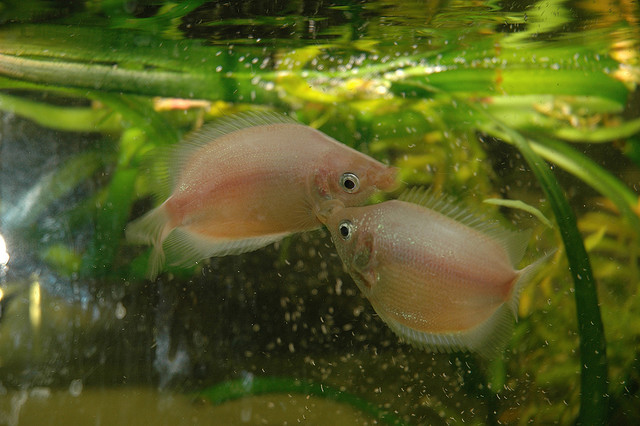
Kissing Gourami Pictures


In the picture above, the Kissing Gourami is not actually kissing, but it was a power struggle to determine who is more power over its territory. Kissing Gourami There are two colors: green and pink. In nature, size bias reached 30 cm, while at the aquarium, about 10-15 cm only.

The name "Helostoma" comes from the Greek word meaning mouth upside down, because when the fish's lips is not extended, will be in a position rolled back. While the name "temminckii" is to honor the inventor of this fish, CJ Temminck, a professor of zoology and physics from the Netherlands. "Kissing Gourami" including fish-eating moss, so well incorporated into the new aquarium installed.

Read more

Exotic Tropical Fish


Tiger Barb The Exoticism from Asian Rivers


Originally from the rivers of Sumatra, Tiger Barb fish or Barbus Tetrazona have a very agile movements and nimble. This tropical fish species is very nice when displayed in large quantities.
You'll find a unique nature of this ornamental fish when you feeding tiger barb. That is his habit who grabbed the feed so fast and sometimes even food have not had time to absorb water.

Giving the aquarium plant will increase the attractiveness of Tiger Barb and based on color, Barbus Sumatra grouped into 3 types, namely:

1) Barbus Sumatra, brownish yellow with black lines.
2) Green Tiger Barb with a light green color to a dark green.
3) Barbus Albino with white color.

Among these 3 species, Green Tiger Barb is the most expensive price.


Read more

Popular Tropical Ornamental Fish


Black Ghost (Apteronotus Albifrons) is a quite popular tropical ornamental fish in the world. The black color of it body with little white on the tail and head, make this fish called as black ghost.

Despite its name spooky, this freshwater ornamental fish is not daunting. Precisely leaf shape of its which resembles a flattened sideways and long make it look very attractive.

Black ghost fish lovers generally wanted the fish with shiny black skin and smooth texture like a bat with the fin color should actually meeting with no rips.

Beautiful tropical ornamental fish are known pleased attached to the substrate and likes to hide in a hole. Apparently the ghost of aquarium is also quite shy.
Read more

Arowana The Fish of God


Color and shape of this tropical fish pictures which is the strong attraction and make arowana become a one of a famous freshwater ornamental fishes. Even for some people, this fish is regarded as the bearer of hockey to become another attraction for the fans.

Based on its origin, this tropical fish divided into 2 groups. First, The Arowana fish originating from Brazil and the second arowana from Indonesia (Asia). Brazilian Arowana the shape was flat sideways elongated and tapered toward the tail. The dorsal fin and pelvic fins also extends to the tail so the tail fin to appear narrow. The composition between scales less or not so obvious. However, the majority of these breed of Arowana was silvery white or black.


There are two types of Arowana native of Indonesia. First, Sclerophagus Formous which originated from Kalimantan (Borneo) and Sumatra and the second species, which originating from Irian (New Guinea). Both breeds of these freshwater fish arowana's has the same body, which is rather thick and extends, but does not taper toward the tail. Shape of his head straight with a wide mouth facing upwards. Big eyes and mutter in his lower lip. Dorsal and pelvic fins toward the tail is relatively small. Pectoral fin nearly triangular shape with a size not too big and a rounded tail fin. The size of the large scales with formation of a visible making this tropical fish looks very interesting.


In world markets, compared to The Silver Sclerophagus Jardini from Papua - Sclerophagus formous from Kalimantan and Sumatra have a more high price and known by the nickname as "The Star of Indonesian Ornamental Fish".

The color of this tropical fish is really diverse. But the most expensive and popular is the red. According to belief, arowana fish - especially the red also known as "The Fish of God" that brings a good luck. Not surprisingly, the price of this fish can reach thousands of dollars per tail.
Read more